Essay. June 2026.
Summary
Enterprise AI adoption is rising, but the measured returns remain modest and uneven. The gap is, at root, a problem of representation rather than intelligence. As enterprises move from systems that answer to systems that act, the decisive asset becomes a faithful, shared, machine-actionable model of how a specific business actually works. Computer science has long called this an ontology. What an ontology contains, where ontologies already run at scale, how an autonomous agent uses one at the moment of decision, and why an idea once dismissed as belonging to an earlier era of AI is re-emerging as the most defensible layer in the enterprise AI stack.
1. The gap between adoption and integration
The picture painted by independent data is more sober than the headlines suggest. The United States Census Bureau tracks firm-level AI use every two weeks through its Business Trends and Outlook Survey, a nationally representative instrument covering roughly 200,000 businesses. Under its original, narrower question about using AI to produce goods and services, adoption sat in the low single digits through 2023 and 2024 (Bonney et al., 2024). After the question was broadened in late 2025 to cover any business function, the figure rose to around 18% of firms, or about 32% once weighted by employment (U.S. Census Bureau, 2026).
A Federal Reserve research note synthesising several government and academic surveys draws out the revealing contrast. While roughly 41% of individuals report using generative AI for work, only about 18% of firms have integrated it at the organisational level (Allen, 2026). Personal, ad-hoc use is running well ahead of deliberate enterprise integration. The bottleneck is not access to capable models, which are now a commodity, but the far harder work of wiring them into how an organisation actually operates.
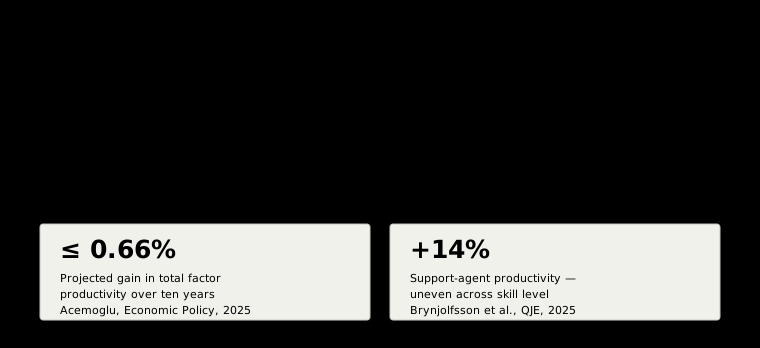
What value has been measured is real but bounded. In the most rigorous economy-wide assessment to date, Acemoglu models AI’s effect through a task-based framework and concludes that the gain to total factor productivity over a decade is non-trivial but modest, on the order of half a percentage point and possibly less (Acemoglu, 2025). His reasoning matters more than his number. The early productivity evidence comes from easy-to-learn tasks with clear feedback, whereas the larger future gains must come from hard-to-learn, context-dependent decisions for which there is often no objective signal to learn from. Those context-dependent decisions are precisely what an enterprise ontology encodes.
The micro-evidence agrees. In a large field experiment with more than five thousand customer-support agents, Brynjolfsson, Li and Raymond found that access to a generative-AI assistant raised productivity by about 14% on average, but the gains went overwhelmingly to less-experienced workers, with little benefit to the most skilled, because the system largely captured and redistributed the tacit know-how of the best performers (Brynjolfsson, Li & Raymond, 2025). AI helped most where it could surface an organisation’s own latent expertise. Capability alone did not.
2. From answering to acting
To see why representation is becoming the constraint, notice that the workload itself is changing shape. A question-answering system has a forgiving error profile. If it returns something wrong, a human reader usually notices and discards it, so the cost of a mistake is small and locally contained. For retrieval and drafting, fluency can therefore carry a system a long way, because a person remains in the loop.
An agent is different. Its defining feature is that it removes the human from the inner loop by design, planning and executing multi-step work that writes back to real systems. That is the source of its value and also of its risk: when an agent issues a refund, reassigns an account or triggers a purchase order, the cost of an error is no longer an inconvenience but a financial, operational or compliance event.
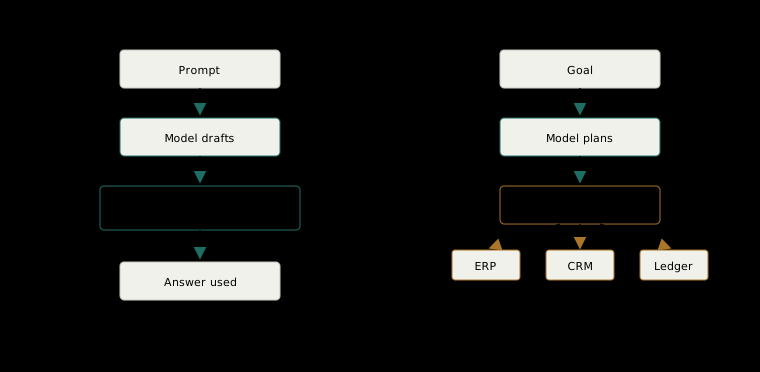
At that point fluency stops being sufficient, because of a well-documented property of large language models. In the most comprehensive recent survey of the phenomenon, Huang and colleagues distinguish two kinds of hallucination: factuality hallucination, where output diverges from real-world fact, and faithfulness hallucination, where output diverges from the user’s instruction, the supplied context, or its own internal logic (Huang et al., 2025). Both are intrinsic to systems that generate text by predicting probable continuations rather than by consulting a verified record. A grammatically flawless instruction issued against a misunderstood account schema is not a harmless slip; it is a confident, well-written and possibly costly mistake. The move from answering to acting converts a tolerable weakness into an unacceptable one, precisely at the boundary where the system needs an accurate model of the business to behave correctly.
3. What an ontology actually is
The word carries philosophical baggage, so precision helps. In computer science the canonical definition originates with Gruber, who characterised an ontology as an explicit specification of a conceptualisation, that is, a formal description of the concepts and relationships that can exist for a community of agents (Gruber, 1993, 1995). Studer and colleagues refined this into the formulation now standard in the literature: a formal, explicit specification of a shared conceptualisation (Studer, Benjamins & Fensel, 1998). Each adjective does work. Formal means machine-readable; explicit means the concepts and the constraints on their use are stated rather than assumed; shared means the model captures consensus accepted by a group, not one person’s private view.
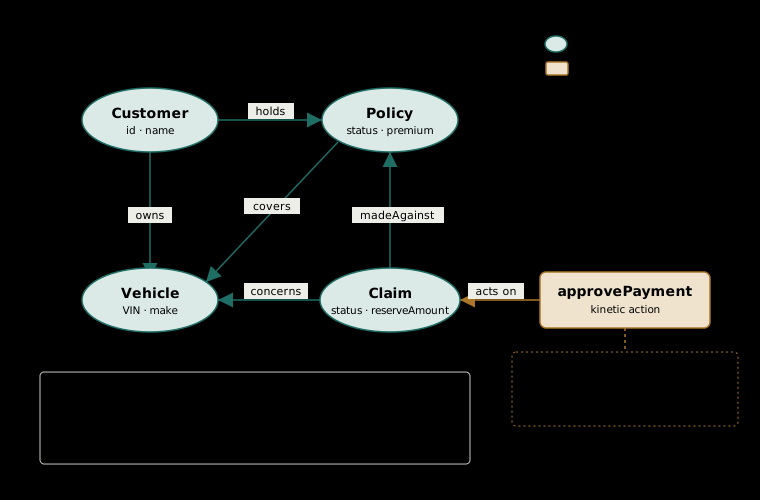
It helps to distinguish an ontology from the two things it is most often confused with. A taxonomy is a hierarchy of categories, such as product → electronics → laptop, and nothing more. A data schema specifies how a particular database stores rows and columns. An ontology sits above both. It states the entities that exist (Customer, Account, Claim), the relationships that may hold between them (Account belongsTo Customer; Claim madeAgainst Policy), and the axioms and constraints that must remain true (every Claim references exactly one Policy; a Policy cannot be both Lapsed and Active). In the dominant standards, these statements are expressed as machine-readable triples in the W3C’s Resource Description Framework and given logical meaning by the Web Ontology Language (OWL), which is grounded in description logic, a decidable fragment of formal logic that lets software reason over the model by classifying entities, inferring implied relationships, and detecting contradictions automatically (W3C, 2012). Validation rules can be layered on with the W3C’s Shapes Constraint Language (SHACL), and human-readable labels and looser hierarchies with SKOS (W3C, 2017).
Two features matter most for enterprise AI, and both are routinely underestimated.
The first is that an ontology is fundamentally about agreement. It is the single place where the data layer, the business logic and the AI converge on what the words mean. Consider the word customer. To the marketing system it may mean anyone who has registered an email; to finance, only an entity with a billing relationship; to support, the individual who opened a ticket. Three definitions, stapled together by tribal knowledge, are tolerable when humans mediate every hand-off. They are not tolerable when an agent must decide, unsupervised, whether a given party is owed a refund. An ontology resolves that ambiguity once, deliberately, so every system above it inherits one consistent vocabulary. This is not a hypothetical concern. The Financial Industry Business Ontology, discussed below, exists in large part because the same concept, whether a counterparty, a beneficial owner or an interest rate swap, is defined differently in every internal system and every regulatory regime, and someone has to make those definitions agree (EDM Council & OMG, 2024).
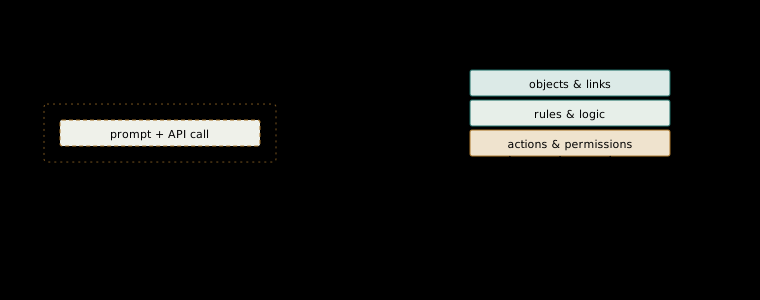
The second feature distinguishes an ontology built for agents from a knowledge graph built for analytics. Analytics asks what is true. An agent additionally needs to know what may be done, by whom, under what conditions, and with what consequence. This is not a recent commercial insight but a long-standing strand of academic work. Research on formal ontology for information systems (Guarino, 1998) and on enterprise ontology as the implementation-independent essence of an organisation (Dietz, 2006) treats action and process as first-class notions that must be defined as precisely as objects and relations. An operational ontology therefore pairs a semantic layer (objects, properties, links) with a kinetic one: the actions an agent may take, the rules that constrain them, and the permissions that govern who may act. It is the difference between a map and a set of traffic laws. An enterprise needs both, but only the second keeps an autonomous system from driving into the river.
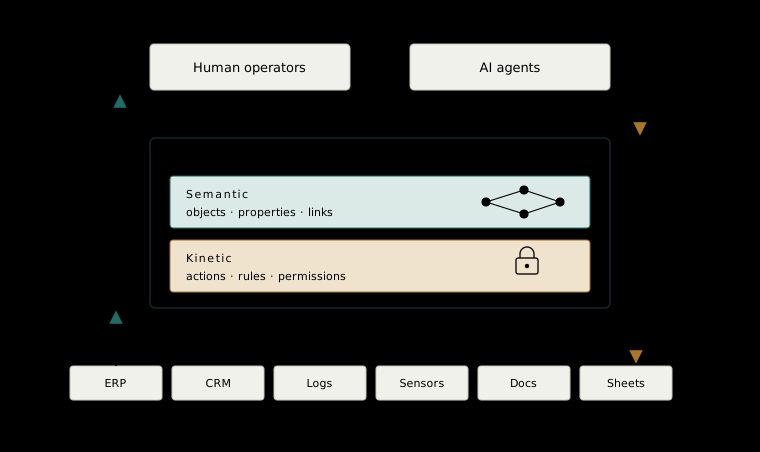
A stylised example makes the two layers concrete. Suppose an insurer wants an agent that can settle a straightforward motor claim. The semantic layer would declare the relevant objects and links: a Claim is madeAgainst a Policy, which is heldBy a Customer, who owns a Vehicle; a Claim has a status drawn from a fixed set, and a reserveAmount. The kinetic layer would declare the permitted moves and their guards. The action approvePayment may fire only when the claim’s status is Assessed, the amount falls below an authority threshold, and no open fraud flag is attached; it must record who authorised it, and it may not run twice on the same claim. The axioms enforce coherence, so that a claim cannot be Paid before it is Approved, and the permissions encode who, whether human or agent, is allowed to pull each lever. None of this lives in the model’s weights. It is the explicit, shared, machine-checkable substance of how this insurer settles a claim.
4. This is not theoretical: ontologies already run at scale
A reasonable objection is that operational ontologies sound elegant on paper but unproven in practice. The record says otherwise. Some of the most demanding and heavily scrutinised information systems in the world are built on exactly this foundation.
In finance, the Financial Industry Business Ontology (FIBO) is an open, industry-standard ontology developed by the non-profit EDM Council together with the Object Management Group. It is expressed in OWL, grounded in description logic so that each concept is unambiguous and machine-reasonable, and supplemented with SHACL shapes for data validation and SKOS for human-readable labels (EDM Council & OMG, 2024). Its purpose is precisely the agreement problem described above. It gives institutions a single authoritative definition for concepts such as legal entities, instruments and beneficial ownership, against which they map the disparate models held in their trading, risk and compliance systems. One motivation is regulatory: a common, machine-readable model lets a bank generate reports against requirements such as the Basel Committee’s BCBS 239 risk-data-aggregation principles, or Legal Entity Identifier filings, from one consistent representation rather than from bespoke pipelines built for each regulator (EDM Council & OMG, 2024). FIBO is also a useful corrective to over-optimism, because it has been developed over more than a decade by a large community precisely because reaching consensus on what financial terms mean is slow, contested work.
In the life sciences, the Gene Ontology, introduced in a paper now among the most cited in all of biology, provides a dynamic, controlled vocabulary describing gene and gene-product function that can be applied consistently across all eukaryotic organisms (Ashburner et al., 2000). It lets findings from a fly, a mouse and a human be annotated against the same formal terms and compared, and it is maintained by an international consortium as biological knowledge changes. In medicine, SNOMED CT is a large clinical terminology built on description logic and used inside electronic health records across many national health systems. Its concepts are arranged by logical subsumption, so that Diabetes mellitus is formally a kind of Disorder of glucose metabolism, which lets software infer relationships and check the terminology for contradictions automatically. Both show ontologies operating under sustained scientific and clinical scrutiny, at a scale of hundreds of thousands of concepts, with automated reasoning doing real work.
Closer to the commercial mainstream, a peer-reviewed account by Noy and colleagues, who are engineers and scientists from Google, Microsoft, IBM, Facebook and eBay, describes how each of these companies built large knowledge graphs to supply structured, factual grounding to their products (Noy et al., 2019). eBay’s Product Knowledge Graph encodes products, entities and their relationships; IBM’s framework underpins parts of its Watson Discovery offerings; Google’s knowledge graph supplies the structured entities behind search. The authors are candid that building and, especially, maintaining these graphs at industrial scale is difficult. Entity resolution, keeping multiple stores in sync, and ingesting new knowledge without rebuilding everything are all recurring challenges (Noy et al., 2019). That candour is part of the value. It shows the approach is real, deployed and load-bearing, and also that it is genuinely hard, a tension worth keeping in mind.
5. How an agent uses an ontology at the moment of decision
The reason this matters now is that an ontology changes what happens in the seconds before an agent acts. Without one, a language-model agent answers from its parameters and whatever text it happened to retrieve, and its fluency is the only thing standing between the organisation and a confident error. With one, the agent has a structured, authoritative substrate to consult and to be constrained by.
A grounded decision runs roughly as follows. First, resolve: map the entities mentioned in the request, such as a customer name or an account number, to the canonical objects in the ontology, so the agent is reasoning about the right Customer and not a near-namesake. Second, traverse and retrieve: follow the explicit links to assemble exactly the relevant context, namely this policy, its claims and its open flags, and supply that to the model. This is the logic behind retrieval-augmented generation, introduced by Lewis and colleagues to reduce non-factual output by grounding the model in retrieved evidence (Lewis et al., 2020), and behind its graph-based successors, which use the structure of a knowledge graph to gather context that scattered text lookup would miss (Edge et al., 2024; Pan et al., 2024). Third, check: before any action fires, test it against the kinetic layer. Does the claim’s status permit payment, is the amount within authority, and does this agent hold the permission? Description-logic reasoning and SHACL validation can catch a contradiction or a violated constraint before it becomes an executed mistake, not after. Only then does the agent act, with the action and its justification recorded.
The ontology does not make the model honest; it makes dishonesty expensive to act on. A faithfulness error that survives the model’s own generation still has to pass the explicit constraints before it can move money. That is the practical meaning of grounding, and it is why the structured substrate matters far more for an agent than it ever did for a chatbot.
6. The return of an unfashionable idea
The intellectual history matters, because it explains both why ontology was neglected and why it is returning in a new form. Structured knowledge representation has been out of fashion for two decades. The Semantic Web programme of the early 2000s, namely Berners-Lee, Hendler and Lassila’s vision of a web of machine-readable meaning realised through formalisms such as RDF and OWL, was ambitious but, in its most maximalist forms, commercially disappointing (Berners-Lee, Hendler & Lassila, 2001). Hand-authoring a formal model of a living business proved punishingly expensive, and such models tended to go stale the day they were finished. When large language models arrived, the implicit promise was that all this structure could be discarded: rather than model the world, simply train a model large enough to have absorbed it.
The more considered position emerging from recent research is that large models do not make ontology obsolete; they change its economics and raise its stakes at the same time. The field of neuro-symbolic AI, which combines the pattern-learning strengths of neural networks with the explicit, verifiable reasoning of symbolic systems, has grown rapidly since 2020, and a 2024 systematic review of the literature finds knowledge representation among its most active areas (Colelough & Regli, 2024). The motivation is well established: large models struggle with logical consistency and with reasoning reliably beyond their training distribution, and integrating explicit symbolic knowledge is a leading remedy (Wang, Yang & Wu, 2024).
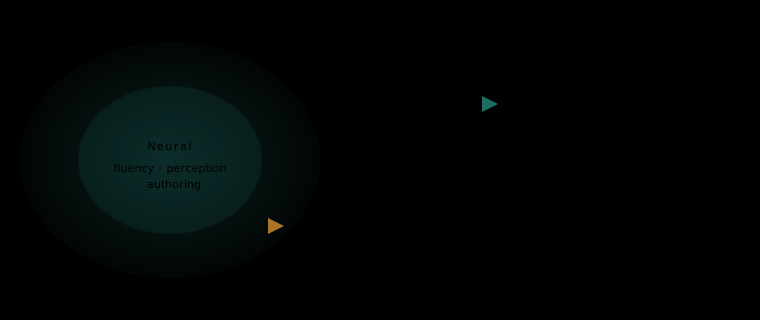
Two developments pull in the same direction. First, models have made ontology tractable. The same language models that act on a knowledge base can now help build and maintain it, reading schemas, documents and code to propose entities and relationships, and flagging where the model and reality have drifted apart. This is an active research area, with work on language-model-assisted ontology learning and requirements engineering appearing at the European and Extended Semantic Web Conferences (Lippolis et al., 2025; Zhao et al., 2024). The bottleneck that once made knowledge engineering uneconomic, the very one that frustrated the Semantic Web, is now being lowered by the very technology that seemed poised to render it obsolete.
Second, the empirical case for grounding has strengthened, as section 5 described: retrieval-augmented and graph-based methods consistently use explicit structure to constrain a fluent model (Lewis et al., 2020; Edge et al., 2024; Pan et al., 2024). The resulting picture is not a return to the old position but a synthesis. The neural component supplies fluency, perception and low-cost authoring; the symbolic ontology supplies ground truth, constraints and accountability. The model keeps the ontology from fossilising; the ontology keeps the model from acting on a misunderstanding. They co-evolve.
7. Why the ontology is the moat
For a company building in this space, the argument has a direct commercial consequence, and it bears on the question every founder eventually faces: what stops the model provider, the incumbent vendor, or a competitor with the same model access from doing exactly what you do? If the answer is the model, there is no answer, because the model is rented and shared. If the answer is the ontology, there is something durable, for three reasons.
It is proprietary. An enterprise ontology encodes how a particular business works, a body of knowledge that exists in no public corpus and cannot be scraped, because much of it is not written down anywhere. This is the economist’s notion of tacit knowledge: the know-how an organisation possesses but cannot fully articulate (Polanyi, 1966). The field experiment cited earlier showed AI delivering value precisely by capturing and redistributing that tacit expertise (Brynjolfsson, Li & Raymond, 2025); the act of building an ontology is the act of codifying it deliberately rather than by accident. FIBO took a standards consortium more than a decade to negotiate, not because the technology was missing but because agreeing what the terms mean is the hard part, and that difficulty is exactly what makes the result hard to copy (EDM Council & OMG, 2024).
It compounds. Each workflow modelled, each edge case resolved, each rule encoded lowers the cost of the next and raises the trustworthiness of the whole. The asset improves with use rather than decaying, so a lead tends to widen rather than erode. And it is slow: the ontology cannot be cloned over a weekend, precisely because most of it must be excavated from the organisation one contested definition at a time. For a startup, slow is ordinarily a liability; here it is the point, because the thing that takes many months to build is the thing a competitor needs many months to copy. This also aligns with Acemoglu’s argument that the remaining productivity gains lie in hard-to-learn, context-dependent decisions with no objective signal to learn from (Acemoglu, 2025), since those are exactly the decisions an ontology makes explicit. The contrast is with the much-criticised wrapper, a thin layer whose only contents are a prompt and an API call, which an incumbent can absorb at will. The defensible company is the one whose hardest asset is the model of the business, not the model doing the talking.
8. The honest limitations
A claim of this kind should be tested against its weaknesses, of which there are several.
Ontologies are expensive and they rot. The scale of FIBO, the Gene Ontology and SNOMED CT is also a warning. These are the products of large, sustained, well-funded communities, and the industrial knowledge-graph teams that Noy and colleagues describe spend much of their effort simply keeping the graph in sync with reality (Noy et al., 2019). Businesses reorganise, definitions drift, and a model no one maintains becomes worse than none, because people keep trusting it after it has begun to lie. The new ability to enlist models in keeping an ontology current is therefore not a convenience but a precondition; without it, the economics may not close.
Ontologies are also not a universal solvent. The clinical-informatics literature documents cases where even a mature, carefully engineered terminology like SNOMED CT cannot cleanly express certain notions. Negation and temporal scope are recurring difficulties, because the underlying logic has deliberate expressive limits. Formal precision buys decidable reasoning at the cost of some things being awkward or impossible to say. An ontology raises the floor on reliability; it does not capture everything, and pretending otherwise repeats the over-reach that discredited the field the first time.
There is also the opposite failure mode, and it is the original sin of the Semantic Web: the temptation to model everything before shipping anything. Comprehensiveness is the enemy of deployment. The discipline is to model the minimum that lets one agent act safely on one workflow, prove it, and let the ontology grow along the paths that real actions take. And beneath the optimism sit unresolved research problems, notably the reliable grounding of a neural model’s continuous representations in discrete symbols, which recent work treats as an open frontier rather than a solved matter (Colelough & Regli, 2024). Explicit structure reduces but does not eliminate hallucination; faithfulness failures can persist even with correct context (Huang et al., 2025). Governance and human oversight remain necessary.
Finally, a note of caution about the central claim itself. That the ontology is the moat is a thesis consistent with the present evidence, not a proven law. The economic estimates are early and contested, and the strongest evidence for the agentic shift is still arriving. The argument should be held as the best current reading of the direction of travel, open to revision as harder data appears.
Conclusion
The enterprise AI paradox, of adoption rising while returns stay modest and uneven, is best understood not as a failure of intelligence but as a failure of representation. As organisations move from systems that answer to systems that act, the cost of misunderstanding the business rises sharply, and the decisive question shifts from how capable is the model to how faithfully does the system understand this particular enterprise. The second question has a defensible answer, and its name is an old one. The ontology, now formal, explicit, shared, and extended to encompass not only what is true but what may be done, is re-emerging as the layer where durable advantage in enterprise AI is most likely to be found. We already know it can carry the weight, because it underpins financial regulation, the unification of biology and the clinical record. The intelligence was never going to be the scarce thing. Understanding is.
References
Acemoglu, D. (2025). The simple macroeconomics of AI. Economic Policy, 40(121), 13–58.
Allen, J. S. (2026). Monitoring AI adoption in the U.S. economy (FEDS Notes). Board of Governors of the Federal Reserve System.
Ashburner, M., Ball, C. A., Blake, J. A., Botstein, D., Butler, H., Cherry, J. M., … Sherlock, G. (2000). Gene Ontology: Tool for the unification of biology. Nature Genetics, 25(1), 25–29.
Berners-Lee, T., Hendler, J., & Lassila, O. (2001). The Semantic Web. Scientific American, 284(5), 34–43.
Bonney, K., Breaux, C., Buffington, C., Dinlersoz, E., Foster, L., Goldschlag, N., Haltiwanger, J., Kroff, Z., & Savage, K. (2024). Tracking firm use of AI in real time: A snapshot from the Business Trends and Outlook Survey (NBER Working Paper No. 32319; U.S. Census Bureau CES-WP-24-16). National Bureau of Economic Research.
Brynjolfsson, E., Li, D., & Raymond, L. (2025). Generative AI at work. The Quarterly Journal of Economics, 140(2), 889–942.
Colelough, B. C., & Regli, W. (2024). Neuro-symbolic AI in 2024: A systematic review. CEUR Workshop Proceedings, 3819. (Preprint arXiv:2501.05435.)
Dietz, J. L. G. (2006). Enterprise ontology: Theory and methodology. Springer.
Edge, D., Trinh, H., Cheng, N., Bradley, J., Chao, A., Mody, A., Truitt, S., & Larson, J. (2024). From local to global: A Graph RAG approach to query-focused summarization. arXiv:2404.16130.
EDM Council & Object Management Group. (2024). Financial Industry Business Ontology (FIBO) [Standard specification and documentation]. Enterprise Data Management Council; Object Management Group.
Gruber, T. R. (1993). A translation approach to portable ontology specifications. Knowledge Acquisition, 5(2), 199–220.
Gruber, T. R. (1995). Toward principles for the design of ontologies used for knowledge sharing. International Journal of Human-Computer Studies, 43(4–5), 907–928.
Guarino, N. (1998). Formal ontology and information systems. In N. Guarino (Ed.), Proceedings of FOIS’98 (pp. 3–15). IOS Press.
Huang, L., Yu, W., Ma, W., Zhong, W., Feng, Z., Wang, H., Chen, Q., Peng, W., Feng, X., Qin, B., & Liu, T. (2025). A survey on hallucination in large language models: Principles, taxonomy, challenges, and open questions. ACM Transactions on Information Systems, 43(2), Article 42.
Lewis, P., Perez, E., Piktus, A., Petroni, F., Karpukhin, V., Goyal, N., Küttler, H., Lewis, M., Yih, W., Rocktäschel, T., Riedel, S., & Kiela, D. (2020). Retrieval-augmented generation for knowledge-intensive NLP tasks. Advances in Neural Information Processing Systems, 33, 9459–9474.
Lippolis, A. S., Saeedizade, M. J., Keskisärkkä, R., Zuppiroli, S., Ceriani, M., Gangemi, A., Blomqvist, E., & Nuzzolese, A. G. (2025). Ontology generation using large language models. In The Semantic Web – ESWC 2025 (pp. 321–341). Springer.
Noy, N. F., Gao, Y., Jain, A., Narayanan, A., Patterson, A., & Taylor, J. (2019). Industry-scale knowledge graphs: Lessons and challenges. Communications of the ACM, 62(8), 36–43.
Pan, S., Luo, L., Wang, Y., Chen, C., Wang, J., & Wu, X. (2024). Unifying large language models and knowledge graphs: A roadmap. IEEE Transactions on Knowledge and Data Engineering, 36(7), 3580–3599.
Polanyi, M. (1966). The tacit dimension. University of Chicago Press.
Studer, R., Benjamins, V. R., & Fensel, D. (1998). Knowledge engineering: Principles and methods. Data & Knowledge Engineering, 25(1–2), 161–197.
U.S. Census Bureau. (2026). Business Trends and Outlook Survey: Artificial intelligence supplement. U.S. Department of Commerce.
Wang, W., Yang, Y., & Wu, F. (2024). Towards data- and knowledge-driven AI: A survey on neuro-symbolic computing. IEEE Transactions on Pattern Analysis and Machine Intelligence.
W3C. (2012). OWL 2 Web Ontology Language document overview (2nd ed.). World Wide Web Consortium.
W3C. (2017). Shapes Constraint Language (SHACL). World Wide Web Consortium.
Zhao, Y., Zhang, B., Hu, X., Ouyang, S., Kim, J., Jain, N., de Berardinis, J., Meroño-Peñuela, A., & Simperl, E. (2024). Improving ontology requirements engineering with OntoChat and participatory prompting. Proceedings of the AAAI Symposium Series, 4, 253–257.