Essay. January 2026.
Summary
Organisational memory is a well-established research field with more than three decades of work behind it. At its core is a foundational definition: what an organisation knows is not the same as what it can retrieve when it needs it. Memory is not storage. It is addressable storage.
The literature spans the canonical retention-bin framework of Walsh and Ungson, the social-cognitive layer of transactive memory, the knowledge management movement's attempt to solve the problem and its qualified failure, and a growing body of evidence on how organisations forget.
The problem has become more acute, not less, in an era of sustained turnover, hybrid work, and decisions made in ephemeral conversation.
The most important distinction in the field is between intentional and unintentional forgetting, and what each implies for how memory infrastructure should be designed. The goal is not to capture everything but to make what is captured addressable on demand.
The emerging direction is a shift away from documentation towards systems that capture and surface organisational knowledge as a by-product of work. This is the most significant development in the field since its founding.
The recurring moment
Somewhere in the middle of a quarter, a meeting opens with a question that should be easy.
“Did we already decide this in March?”
Nobody is sure. Someone remembers a discussion. Someone else recalls a different outcome. A third person searches Slack, scrolls for a while, gives up, and opens a document instead.
Twenty minutes later, the group has reconstructed part of a decision that already exists somewhere, in someone’s head or in a thread or buried in last quarter’s notes, but not in a form anyone can reliably access at the moment it is needed.
This is not a documentation problem. It is a memory problem.
For more than three decades, organisational scholars have studied how companies remember, forget, and re-discover what they already know. The work has lived mostly in academic journals, far from the operational chaos it describes. But three forces have made the field’s central question newly urgent: sustained turnover, hybrid work, and the conversational drift of modern decision-making.
The canonical definition
The field of organisational memory is often traced to a single paper: James Walsh and Gerardo Ungson’s 1991 article in the Academy of Management Review. Their definition has survived essentially unchanged for thirty-four years:
Organisational memory is stored information from an organisation’s history that can be brought to bear on present decisions. (Walsh & Ungson, 1991)
That sentence does more work than it appears to. It separates information that exists from information that can be retrieved when needed. A company can possess a piece of knowledge, in someone’s head, in a folder, in a recorded call, and still functionally not have it, because no one can find it at the moment a decision is being made. Memory, in their formulation, is not storage. It is addressable storage.
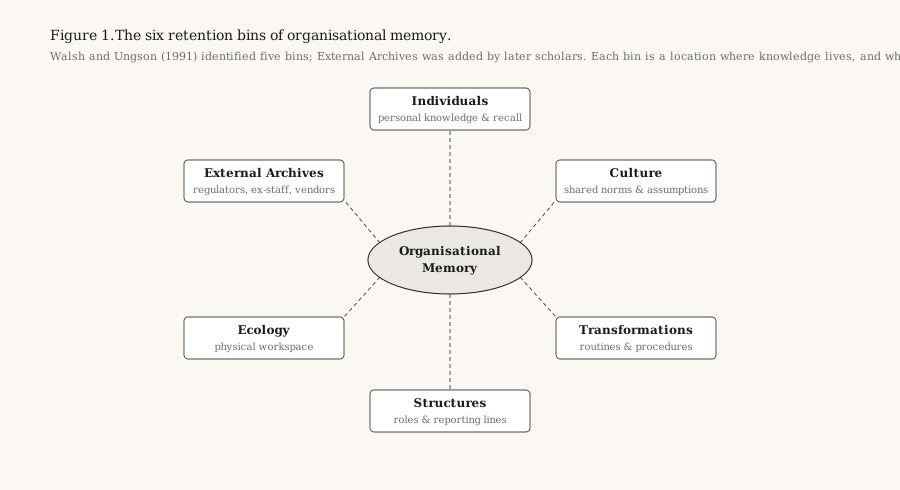
Walsh and Ungson also offered a structure that the field has been refining ever since. They argued that organisational memory is distributed across five retention bins:
- Individuals: what employees personally recall, infer, and habituate.
- Culture: the shared assumptions, language, and norms that encode past lessons.
- Transformations: the procedures, routines, and workflows that embody prior learning.
- Structures: the formal roles and reporting relationships that fix who handles what.
- Ecology: the physical workspace and its layout, which shapes who interacts with whom.
A sixth bin, external archives, was added by later scholars to cover artefacts that live outside the organisation: regulators, ex-employees, vendors. A recent systematic review confirms that this storage-bin model remains the dominant framework for thinking about organisational memory, even as the literature has extended it in new directions (Galan, 2023a).
The implication is straightforward: most of what an organisation “knows” is not written down. It lives in people, habits, and rooms.
Transactive memory: the social layer
The Walsh-Ungson framework treats memory as a property of an organisation. A separate research line, older but more cognitively grounded, treats it as a property of a group.
Daniel Wegner’s transactive memory theory, introduced in 1987, observed that close-knit groups behave as if they share a single memory system. The system has two layers: what each person individually knows, and a meta-layer of who knows what. Couples remember different things and trust each other to retrieve the right bits. Surgical teams do the same. So do well-functioning product teams.
The meta-layer matters more than people realise. A team where every member knows everything is rare and arguably wasteful. A team where members know different things but collectively know where to look is the more efficient pattern, provided the directory of who-knows-what is accurate and up to date.
When transactive memory works, groups outperform the sum of their members. When it breaks through turnover, reorgs, or boundary churn, groups underperform even with the same individual expertise still present, because no one knows where to look anymore. A new hire on a team is not just an empty slot waiting to fill; they are a hole in the directory that everyone else has to route around.
Recent research has shifted toward the conditions that make this directory harder to form and sustain in modern work. Yoon, Piercy, Kim and Zhu’s 2024 study in Management Communication Quarterly surveyed 212 employees who divided their time across multiple teams and found that boundary-spanning behaviour (moving between teams via collaboration tools) improved specialisation and credibility within a focal team but actively damaged coordination. The multi-team, multi-tool reality most knowledge workers now inhabit makes the meta-layer of “who knows what” structurally weaker.
A parallel line has begun to examine transactive memory in human-AI teams. Bienefeld and colleagues’ 2023 study in Frontiers in Psychology observed 180 ICU clinicians working alongside an AI system in a simulated environment and found that the strength of the team’s transactive memory, including how it incorporated the AI as a memory partner, predicted team effectiveness. Memory has begun to extend across the human-machine boundary in measurable ways. Whether that extension is healthy or whether it accelerates atrophy of the human directory is the open question.
Why three decades of solutions have not worked
If the problem has been understood since 1991, the obvious question is why organisations still suffer from it so visibly. The answer involves a movement that arrived with enormous confidence and quietly faded without delivering on its central promise.
The Walsh-Ungson framework appeared at almost exactly the same time as the rise of knowledge management (KM) as a distinct discipline. Nonaka and Takeuchi’s 1995 book The Knowledge-Creating Company introduced the SECI model (socialisation, externalisation, combination, internalisation), which became the dominant conceptual scaffold for KM practitioners. Throughout the late 1990s and 2000s, the major management consultancies built large practices around it. Organisations invested heavily in intranets, document repositories, taxonomies, and what the academic literature came to call OMIS (Organizational Memory Information Systems). The premise was simple: if knowledge can be made explicit, it can be stored, retrieved, and reused.
The premise was wrong, or at least incomplete. Empirical critique of the SECI model has accumulated steadily. The foundational claim that tacit knowledge can be reliably converted into explicit knowledge through structured processes has never been strongly supported, and the model itself has been criticised for being shaped by cultural assumptions specific to its Japanese origin rather than reflecting a universal mechanism of knowledge creation. The systems that the movement produced suffered from predictable failure modes: taxonomies that decayed faster than they could be maintained, search interfaces that returned everything except what users wanted, contribution incentives that no one acted on, and a steady accumulation of stale documents that obscured the few useful ones.
Two recent systematic reviews map the resulting picture. Daghfous and colleagues’ 2023 review in the Journal of Enterprise Information Management synthesised 74 peer-reviewed studies on knowledge loss published between 2000 and 2021. The review identifies three durable themes: the drivers of knowledge loss (turnover, ageing workforces, restructuring), its impacts (both negative and, importantly, sometimes positive), and the mitigation strategies that organisations attempt. The mitigation strategies look strikingly similar across two decades: knowledge transfer programmes, documentation initiatives, mentorship pairings, and exit interviews. Igoa-Iraola and Diez’s 2024 systematic review in Heliyon examined knowledge transfer procedures during generational change specifically, identifying 28 studies after PRISMA screening. The conclusion is that the field still lacks a robust, generalisable procedure for transferring expert knowledge from one generation of workers to the next, despite that being one of the longest-standing problems in the discipline.
The honest summary of the KM era is that it produced more durable insight into why organisational memory degrades than into how to prevent it. The systems it built did not, on balance, make organisations remember more reliably. Mohaghegh’s 2024 study in Knowledge and Process Management identifies what may be the underlying issue: knowledge utilisation, not knowledge capture, is the binding constraint on organisational performance. The bottleneck is not what gets stored but what gets retrieved into the right decision at the right time. KM systems were largely optimised for the wrong side of the equation.
How organisations forget
The complement to memory research is organisational forgetting, a smaller but rapidly growing literature that asks how companies lose what they once knew.
The canonical scenario is turnover. Galan’s 2023 systematic review in The Learning Organization synthesised 91 empirical studies on what the field now calls KLT, or Knowledge Loss from Turnover. The review documents an unsettling pattern: organisations experience KLT not as a single dramatic event but as a slow erosion that becomes visible only when a problem returns, a project re-starts, or a regulator asks a question no current employee can answer (Galan, 2023a, 2023b).
A particularly vivid recent case study is Garcias, Dalmasso and Depeyre’s 2024 paper in Project Management Journal, “Can’t Remember What I Forgot.” The authors followed a large engineering organisation attempting its first new project in roughly a decade. The organisation discovered, painfully, that it no longer possessed capabilities it had treated as institutional. These capabilities had lived in people who had retired, in routines that had quietly drifted, and in tacit conventions no one had thought to write down. The paper’s most interesting finding is methodological: organisational forgetting is hard to identify in real time. The authors describe five sources of ambiguity (latency, novelty, multiplicity, complexity, credibility) that cause forgetting to be under-recognised even as it is happening.
The public-sector version of the problem is even better documented, because public inquiries periodically expose it. Alastair Stark’s 2024 article in Policy Quarterly, which synthesises a research programme drawing on roughly 100 interviews with ministers, policy officials, and public-sector leaders across Australia, Canada, New Zealand, and the United Kingdom, offers one of the clearest empirical typologies of institutional amnesia in government. The four causes Stark identifies are organisational churn (staff turnover and restructuring), absorptive capacity (whether the organisation has the cognitive infrastructure to hold lessons), strategic forgetting (the political incentive to leave certain memories behind), and historical storytelling (whether anyone is left who can narrate the past coherently). The pattern he documents is that the same lessons are learned and forgotten repeatedly across electoral cycles. Public inquiries after major failures issue recommendations; the recommendations are notionally accepted; a decade later, a similar failure occurs and a similar inquiry produces a similar set of recommendations (Stark, 2024).
Broekema’s 2025 conceptual article in Risk, Hazards & Crisis in Public Policy extends the same problem to crisis response specifically, arguing that lessons learned after disasters routinely fail to embed and instead decay within a few years.
The cumulative picture from this research is sobering. Organisations forget at industrial scale, mostly without noticing, and the existing mechanisms for not forgetting (manuals, wikis, knowledge bases) have not solved the problem in three decades of trying.
Why the problem is getting worse
A reasonable assumption would be that digital tools should have improved organisational memory. The opposite has happened. Three forces, all intensifying, work against retention.
Turnover has stayed elevated. The Great Resignation years of 2021 to 2022 attracted the most attention, but the underlying pattern of shorter median tenures and higher voluntary mobility has not reverted. Galan’s 2023 review notes that the KLT literature is growing precisely because the phenomenon it studies has become more common, not less. Every departure removes a slice of the “individual” retention bin that Walsh and Ungson identified, and most organisations do not have a replacement mechanism beyond a hastily scheduled handover meeting.
Hybrid work has fragmented where decisions happen. Vartiainen and Vanharanta’s 2024 review in Frontiers in Organizational Psychology argues that most organisations adopting hybrid arrangements have not designed a corresponding knowledge architecture, treating hybridity as a scheduling problem rather than a sociotechnical one. Decisions that used to occur in shared physical space, the corridor conversation, the whiteboard left up overnight, now occur in calls, threads, and direct messages scattered across half a dozen tools. The “ecology” bin in the Walsh-Ungson model has effectively dissolved.
Decision-making has drifted into conversation. This is the least-discussed force and possibly the most important. A growing share of consequential decisions are now made in synchronous calls (product reviews, executive syncs, customer escalations), and they never become documented artefacts. Mohaghegh’s 2024 work identifies utilisation rather than capture as the binding constraint. When the decision itself never enters a system that can be retrieved from, the question of how to surface it later is moot.
These three forces compound. A more mobile workforce makes individual memory more volatile. Hybrid work removes the spatial cues that used to compensate. And the migration of decisions into ephemeral conversation means that even when people stay, the evidence of what they decided does not survive.
A necessary distinction: forgetting is not always failure
There is a counter-argument worth taking seriously, and it changes how the rest of the discussion should be framed.
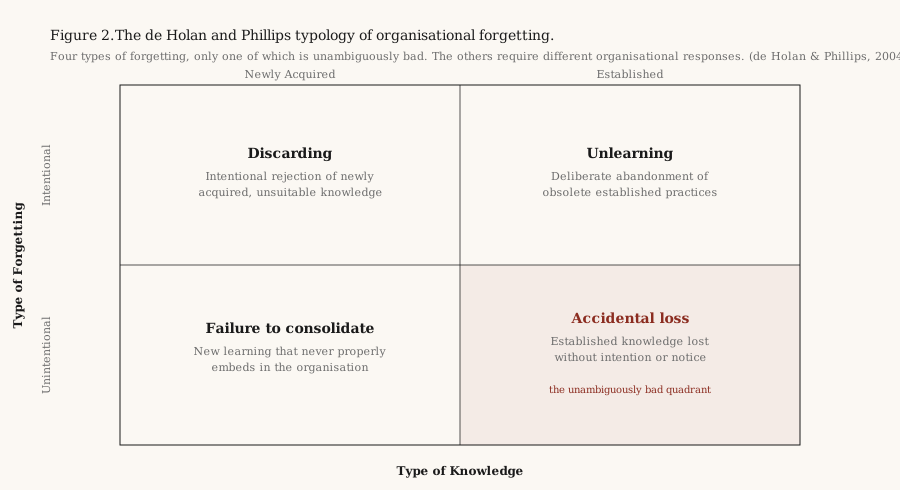
The premise of most popular treatments of organisational memory is that more remembering is better. The research literature is more careful. Pablo Martin de Holan and Nelson Phillips’s 2004 paper in Management Science developed the typology that still anchors this side of the field: forgetting can be intentional or unintentional, and it can affect newly acquired knowledge or established knowledge. The combinations produce four distinct phenomena, only one of which (accidental loss of established knowledge) is unambiguously bad. The other three include the intentional unlearning of obsolete practices, the intentional discarding of newly acquired but unsuitable approaches, and the failure to consolidate new learning. Each requires different organisational responses.
Stark’s 2024 paper asks the question directly in its title: “Institutional amnesia in government: how much is enough?” The argument is that too much forgetting means lessons are never learned, but too much remembering makes organisations rigid, unable to revisit settled assumptions, and trapped by their own prior commitments. Some forgetting is functional. The interesting question is not “how do we stop forgetting?” but “what should we forget, and what must we keep?”
Annette Kluge’s 2023 review in Frontiers in Psychology, which incorporates 31 empirical studies from 2019 to 2022, examines this question at the individual, team, and organisational levels. The review treats intentional forgetting and unlearning as a capability rather than a failure mode, finding that organisations capable of deliberate unlearning are better positioned for cross-boundary innovation and adaptation to changed environments. The research distinguishes carefully between this and the accidental loss of knowledge documented by Galan, Garcias, and others; the two phenomena look superficially similar but require opposite organisational responses.
The goal of organisational memory infrastructure is not to remember everything. That would produce a different pathology, one researchers have started to call organisational ossification. The goal is to remember the right things, retrievably, with provenance and governance attached, while allowing the organisation to consciously let go of what has stopped being useful. Memory and forgetting are complements, not opposites. A serious system has to support both.
The design problem is not capture everything. It is make memory addressable so the organisation can choose what to act on.
From documentation to addressable memory
The historical response to memory problems has been documentation: write it down, file it, search for it later. Knowledge management as a discipline spent the 1990s and 2000s building wikis, knowledge bases, and intranet portals on this assumption. As the previous sections argued, the verdict from the research is that it largely failed: a significant portion of institutional knowledge has remained undocumented across three decades of effort, regardless of the tools available (Daghfous et al., 2023).
The reason is simple. Documentation taxes the moment of creation: someone has to stop, write, and structure. Almost no one does this reliably, and the people whose knowledge is most valuable are usually the busiest. The result is a permanent gap between what an organisation knows and what it has recorded.
The interesting recent shift, both in research and in practice, is from documentation to ambient capture: the idea that memory should accrete as a by-product of work rather than as an extra task on top of it. Zhang and colleagues’ 2024 survey on memory mechanisms in large language model-based agents catalogues a rapid expansion of approaches: episodic memory layers, structured knowledge graphs, retrieval-augmented architectures, and agentic memory systems that update themselves from continuous interaction (Zhang et al., 2024). The research has moved from asking “can we store conversations?” to “can we store them in ways that are governable, retrievable, and trustworthy?”
This is genuinely new territory, and worth being honest about. Ambient memory systems introduce problems the older knowledge-management literature did not have to handle: hallucinated decisions, broken provenance, permission-aware retrieval, temporal drift, and the question of what to forget. The Bienefeld study cited earlier is partly an early empirical investigation of how human teams begin to trust, and mistrust, machine memory partners. None of this is solved. But the direction of research has clearly shifted: away from asking humans to write things down, and toward designing systems that can hold and return organisational state without that tax.
The goal is not to capture everything indiscriminately, but to make captured material addressable and disposable on the organisation’s own terms. This introduces new challenges, including provenance, trust, and governance. But it directly addresses the core issue identified throughout the literature: retrieval failure at the moment of need.
Closing
The most durable insight in the organisational memory literature is also the simplest.
Organisations do not lack information. They lack addressable information at the moment decisions are made.
Thirty years of research has clarified the structure of the problem, named its failure modes, documented its costs, and added an important qualification: the goal is not to remember everything, but to remember the right things, governed and on demand.
The next chapter of the field will be written in operational terms, not theoretical ones. Whether organisations can build infrastructure that keeps what they know, surfaces it at the moment of decision, and lets go of what has stopped being useful will likely be one of the defining capability questions of the next decade. The intellectual foundations have been laid. What remains is to build.
References
Bienefeld, N., Kolbe, M., Camen, G., Huser, D., & Buehler, P. K. (2023). Human-AI teaming: Leveraging transactive memory and speaking up for enhanced team effectiveness. Frontiers in Psychology, 14, 1208019.
Broekema, W. (2025). Conceptualizing organizational forgetting in a crisis context. Risk, Hazards & Crisis in Public Policy.
Daghfous, A., Amer, N. T., Belkhodja, O., Angell, L. C., & Zoubi, T. (2023). Managing knowledge loss: A systematic literature review and future research directions. Journal of Enterprise Information Management, 36(4), 1008–1031.
de Holan, P. M., & Phillips, N. (2004). Remembrance of things past? The dynamics of organizational forgetting. Management Science, 50(11), 1603–1613.
Galan, N. (2023a). Knowledge loss induced by organizational member turnover: A review of empirical literature, synthesis and future research directions (Part I). The Learning Organization, 30(2), 117–136.
Galan, N. (2023b). Knowledge loss induced by organizational member turnover: A review of empirical literature, synthesis and future research directions (Part II). The Learning Organization, 30(2), 137–161.
Garcias, F., Dalmasso, C., & Depeyre, C. (2024). “Can’t remember what I forgot”: Investigating organizational forgetting within a project-based organization. Project Management Journal.
Igoa-Iraola, E., & Diez, F. (2024). Procedures for transferring organizational knowledge during generational change: A systematic review. Heliyon, 10(5), e27092.
Kluge, A. (2023). Recent findings on organizational unlearning and intentional forgetting research (2019–2022). Frontiers in Psychology, 14, 1160173.
Mohaghegh, M. (2024). Analyzing the effects of knowledge management on organizational performance through knowledge utilization and sustainability. Knowledge and Process Management.
Stark, A. (2024). Institutional amnesia in government: How much is enough? Policy Quarterly, 20(1), 3–9.
Vartiainen, M., & Vanharanta, O. (2024). True nature of hybrid work. Frontiers in Organizational Psychology, 2, 1448894.
Walsh, J. P., & Ungson, G. R. (1991). Organizational memory. Academy of Management Review, 16(1), 57–91.
Wegner, D. M. (1987). Transactive memory: A contemporary analysis of the group mind. In B. Mullen & G. R. Goethals (Eds.), Theories of group behavior (pp. 185–208). Springer.
Yoon, K., Piercy, C. W., Kim, Y. J., & Zhu, Y. (2024). Boundary work and transactive memory systems in teams: Moderating effects of the visibility affordance. Management Communication Quarterly, 38(2).
Zhang, Z., Bo, X., Ma, C., Li, R., Chen, X., Dai, Q., Zhu, J., Dong, Z., & Wen, J.-R. (2024). A survey on the memory mechanism of large language model based agents. ACM Transactions on Information Systems.